DNA Solutions connects enterprise platforms to the payment ecosystem: PSP integration, card and SEPA flows, tokenization, 3DS authentication and reconciliation that closes to the cent. Built for European operators where a failed payment is an operational incident.
Most enterprise platforms accumulate payment integrations one provider at a time, each with its own SDK, webhook format and failure behavior. The cost surfaces gradually: authorization rates nobody monitors, finance teams reconciling settlements in spreadsheets, retries that double-charge a customer, and a PCI-DSS audit whose scope keeps growing. We bring the engineering discipline of high-volume billing to the payment layer, so money coming in is handled with the same rigor as money owed.


We design technology that lands on your bottom line. European enterprises trust us with extreme data volumes and critical financial pipelines.
See Client ResultsBy optimizing software licensing fees for several European organizations, we delivered over €1M in annual cost savings.
We built and maintain a Deloitte-audited billing platform processing €300M in audited transactions every month.
A senior team of engineers and consultants across Europe.
T-Systems, Satellic, European Commission: our longest engagements last because we deliver.

A gateway integration is judged on the day a provider degrades. Everything below exists so that day stays uneventful.
Cardholder data is the most expensive data you can store. We design payment flows where the card number travels directly from the customer to the PSP through hosted fields or client-side encryption, and your platform only ever handles tokens. The vaulting strategy is decided deliberately: provider tokens for simplicity, network tokens or an independent vault when portability across PSPs matters. The compliance boundary is documented end to end, including logging, analytics and backup paths, so your PCI-DSS assessment covers a small, well-defined surface instead of your entire platform.
Networks fail mid-payment, and what happens next separates a robust gateway integration from a fragile one. Every operation we send to a PSP carries an idempotency key, every payment is modeled as a state machine with persisted transitions, and retries follow controlled backoff instead of hammering a degraded provider. Webhooks are deduplicated and ordered before they touch your business logic. The outcome: a customer is never charged twice, a timeout never loses a sale that actually succeeded, and your support team stops refereeing ambiguous payment states.
Strong Customer Authentication is mandatory in Europe, but how you apply it decides your conversion rate. We implement 3DS2 flows with deliberate exemption management: transaction risk analysis, low-value exemptions, merchant-initiated transactions for recurring charges, and clean handling of soft declines where an issuer demands a step-up. Frictionless authentication is preferred wherever the issuer allows it, and challenge flows are integrated into your checkout rather than bolted on afterwards. The result is a payment funnel that satisfies PSD2 while losing as few legitimate customers as possible.
An authorized payment is a promise; settlement is the money. We build pipelines that ingest PSP settlement files and payout reports, match them line by line against your own transaction records and your ERP ledger, and account explicitly for fees, refunds, chargebacks, reserves and currency differences. Mismatches land in an exception queue with full context instead of being discovered weeks later by finance. Transaction monitoring runs alongside: authorization-rate drops, webhook lag and duplicate-suspect patterns raise alerts before customers notice anything.
DNA Solutions designs the layer between your platform and the payment ecosystem: orchestration across providers, card and SEPA rails, and the dispute machinery that protects your margin.
What We BuildAn orchestration layer that abstracts every provider behind one internal contract. Transactions are routed by geography, scheme, cost or live authorization performance, with automatic failover when a provider degrades. Adding a PSP becomes an adapter project, and shifting volume between providers becomes a configuration change with real negotiating power behind it.
Full coverage of European payment rails: card acquiring with 3DS2, SEPA Direct Debit with mandate lifecycle management, and clean handling of R-transactions (refusals, returns, refunds) that would otherwise pollute your ledger. Recurring and merchant-initiated flows are wired into your billing engine so subscriptions collect reliably month after month.
Dispute webhooks flow into a structured pipeline: evidence is assembled automatically from order, delivery and session data, representment deadlines are tracked, and outcomes feed back into fraud rules. Chargeback ratios stay visible on a dashboard long before a card scheme program forces the issue, and write-offs follow an explicit workflow.
Tolling, mobility and telecom each collect money on different rails and rhythms. The orchestration core stays constant; the flows around it adapt.
Monthly collection at subscriber scale: SEPA Direct Debit runs, card-on-file renewals under SCA exemptions, dunning flows for failed collections, and reconciliation that ties every payout back to individual subscriber invoices.
Road usage becomes a payment only weeks after the trip. We connect tolling billing engines to PSPs and fleet-card issuers, with settlement matching across countries, currencies and consortium partners.
Mobility platforms collect from drivers and businesses while paying out to partners. We build gateway integrations covering both directions, with wallet balances, deposits and refunds reconciled to the cent.
Two engagements where the payment layer itself was the deliverable: a unified gateway across products, and a multi-country settlement pipeline.
A multi-product platform needed a single payment gateway with reconciliation built in. DNA Solutions built PaySync to unify transactions across every product.
Unified payments and reconciliation
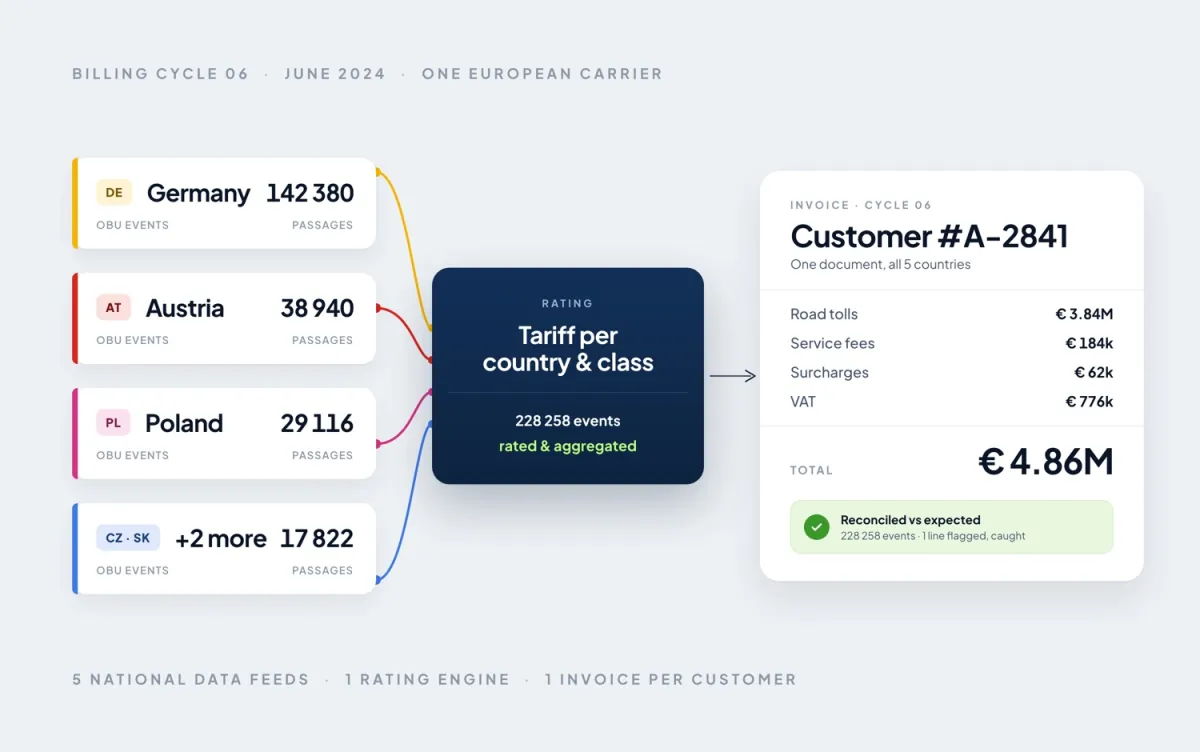
A European tolling consortium needed to rate high volumes of road-usage events into unified, cross-border invoices. DNA Solutions built a microservices billing platform handling multi-country tax and settlement rules.
Audit-grade, multi-countrySenior decision-makers on the billing, tolling and financial platforms we have delivered.
"DNA works with us to deliver digital systems at scale so that we can serve our customers digitally. They are both reactive to requests and proactive with ideas and proposals."
"I appreciated the collaborative spirit and the effort to deliver a reliable solution within a reasonable budget. The step-by-step approach with a demo before deployment made all the difference."
"DNA Solutions has delivered online tools that have made the client's employees and customers' lives easier. For instance, the client can now handle cases in a maximum of two days instead of five."
The points heads of payments raise when they evaluate us for a gateway project.
We work provider-agnostic. Our teams have shipped integrations with the major European processors (Adyen, Worldline, Stripe, Mollie) as well as regional acquirers and bank-direct SEPA rails. More important than any single logo is the architecture: we place an orchestration layer between your platform and the PSP, so every provider is reduced to the same internal contract for authorization, capture, refund and webhook events. Your product code never talks to a PSP SDK directly. That single decision is what later allows you to add a second provider for a new market, negotiate better acquiring fees with real switching power, and survive a provider incident by rerouting traffic. During selection we benchmark candidate PSPs against your actual transaction mix (card versus SEPA share, average ticket, recurring ratio, dispute rate) rather than against feature checklists, because pricing and authorization performance vary heavily by segment.
The goal is for raw card data to never touch infrastructure you operate. We integrate hosted payment fields or PSP-side tokenization so the primary account number flows directly from the customer's browser to the provider, and your platform only stores opaque tokens. Done correctly, this moves most merchants from a heavy SAQ-D assessment toward SAQ-A or SAQ-A-EP, cutting audit effort dramatically. Where business requirements genuinely need card references shared across providers, we introduce network tokens or an independent vaulting service, so tokens stay portable instead of locking you to one PSP. We also review the less obvious leak paths: card numbers landing in logs, in support tickets, in analytics events or in database backups, because that is where assessments usually fail. The result is a documented cardholder-data flow your QSA can sign off on, with the compliance boundary drawn as tightly as possible around third parties rather than around your platform.
Yes, provided the integration is structured for it, and that is exactly what our orchestration layer is for. We normalize each provider behind one internal API covering authorization, capture, refund, mandate management and webhooks, so adding a PSP becomes an adapter project instead of a checkout rewrite. The genuinely hard part is usually the stored credentials: tokens created by one provider cannot be replayed at another. We handle that with network tokenization where card schemes support it, with provider token-migration programs, or with a progressive re-tokenization flow that converts customers at their next successful payment. Routing rules then decide which provider sees which transaction: by country, by card scheme, by cost, or dynamically by recent authorization rates. Most clients run the new PSP in shadow mode first, processing a small share of live traffic while both reconciliation outputs are compared, before any meaningful volume is shifted.
Duplicate charges are an architecture problem, and we design them out at three levels. First, every payment attempt carries an idempotency key derived from your business operation, so a retried request after a timeout returns the original result instead of creating a second charge. Second, each payment lives in an explicit state machine with persisted transitions; a process that crashes mid-capture resumes from the recorded state rather than starting over. Third, we treat the PSP's webhook stream and our own records as two sources that must reconcile: a recovery job continuously compares them, detects attempts that succeeded at the provider but were never confirmed on our side, and resolves them automatically. During PSP outages, requests queue with store-and-forward semantics and replay under the same keys once the provider recovers. Transaction monitoring then alerts on anomalies such as authorization-rate drops and webhook lag before customers notice anything.